
From the American Academy of Audiology
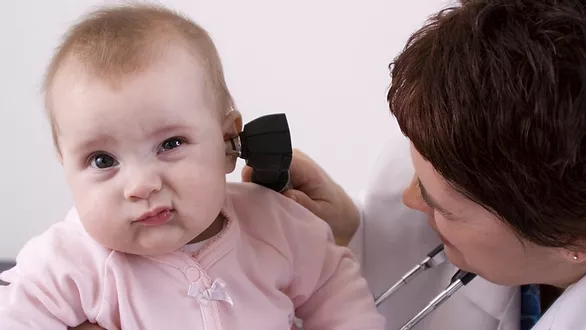
Approximately three of every 1,000 babies have a significant hearing problem at birth.[i]
- More than 5,000 babies are born with hearing loss each year.[ii]
- Babies are not able to tell you they have hearing loss, and the first year of life is critical to the development of normal speech and language.
- Most states require newborn hearing screening tests.
- Infants and young children can have a hearing test at any age.
- If your baby does not pass the hearing screening, you will be asked to bring him or her to a follow up evaluation.
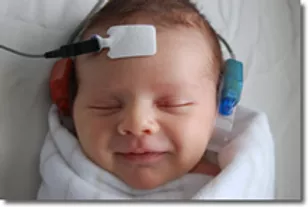
Even if your infant passed a hearing screening but is unable to do some of the following examples (based on his or her age), schedule a follow-up appointment with an audiologist to have his or her hearing checked again.
Hearing loss in infants is a hidden disability. It is important to pay attention to your child’s development and get his or her hearing tested if you have concerns.
An infant with normal hearing should be able to do the following:
Around two months of age
- Startles to loud sound
- Quiets to familiar voices
- Makes vowel sounds like “ohh”
Around four months of age
- Looks for sound sources
- Starts babbling
- Makes squeals and chuckles
Around six months of age
- Turns head toward loud sounds
- Begins to imitate speech sound
- Babbles sounds like “ba-ba”
Around nine months of age
- Imitates speech sounds of others
- Understands “no-no” or “bye-bye”
- Turns head toward soft sounds
Around 12 months of age
- Correctly uses “ma-ma” or “da-da”
- Gives toy when asked
- Responds to singing or music
References
[i] Centers for Disease Control and Prevention (CDC). Identifying infants with hearing loss – United States, 1999-2007. MMWR Morb Mortal Wkly Rep. 59(8): 220-223.
[ii] Centers for Disease Control and Prevention https://www.cdc.gov/ncbddd/hearingloss/2009-data/2009-EHDI_HSFS_Summary_508_OK.pdf